
Emergency communication becomes especially important as Thanksgiving travel season begins. Families take to the highways, winter weather can change quickly, and millions of people depend on their phones for directions, weather updates, and communication.
But what happens when cell service fails?
Winter storms and power outages can disrupt cell service. Damaged equipment and overloaded networks can also cause problems. Even if your phone still works, calls may not go through. Too many people may be trying to use the network at once.
You may stay home for the holidays or travel for Thanksgiving. Either way, emergency communication should be part of your preparedness plan.
A few simple backup options can help you receive important information and stay connected when your phone cannot do the job.
Cell phones depend on much more than the phone in your hand.
Cell towers need power and working equipment. Networks also have limits on how many calls and data connections they can handle at once.
During a major storm or emergency, thousands of people may try to call family members at the same time. That can overload the network.
Your phone battery can also become a problem during a long power outage or road emergency. Once your battery is dead, even a working cellular network will not help you.
A good emergency communication plan should never depend on only one device.
An emergency radio is one of the simplest ways to receive information when the power or internet is down.
A NOAA weather radio can provide warnings and updates about dangerous weather. Depending on the model, you may also be able to receive regular AM and FM stations.
Look for a radio that offers more than one way to stay powered.
Battery-operated radios are useful. Hand-crank and solar models give you more ways to stay powered. Some emergency radios also include flashlights, USB charging ports, and other helpful features.
A small emergency radio can provide vital information during an outage. It can also help while you are away from home for Thanksgiving.
Two-way radios can be useful when family members need to communicate over relatively short distances.
They can help while camping or traveling in separate vehicles. You can also use them to check on neighbors during an emergency.
Unlike cell phones, two-way radios communicate directly with one another and do not depend on a cellular network.
Keep in mind that actual range can vary. Buildings, hills, trees, weather, and other conditions may reduce the distance over which the radios work.
Test your radios before you need them.
Make sure family members know how to turn them on, select the correct channel, and adjust the volume.
And keep spare batteries with your emergency supplies.
CB radios have been around for decades, but they can still have a place in an emergency communication plan.
They can be especially useful for motorists, truckers, RV travelers, and people who frequently drive through areas with poor cellular coverage.
CB radios allow nearby users to communicate without relying on cell towers or internet service.
They are not a replacement for every other form of communication. Instead, think of a CB radio as another option when your usual system is unavailable.
When you are miles from home during holiday travel, another option can be very welcome.
Most of us now depend on our phones for directions.
We type in an address, follow the blue line, and rarely give it another thought.
But cellular data may not always be available.
Some phone maps can work without cell service. Just download the maps before you leave. A dedicated handheld GPS gives you another backup. It can be useful while camping, hiking, evacuating, or traveling in remote areas.
And do not overlook traditional navigation tools such as a compass and paper map.
A road atlas or state map does not need batteries, a charging cable, cell service, or Wi-Fi.
Sometimes simple backup equipment is still some of the most dependable equipment you can own.
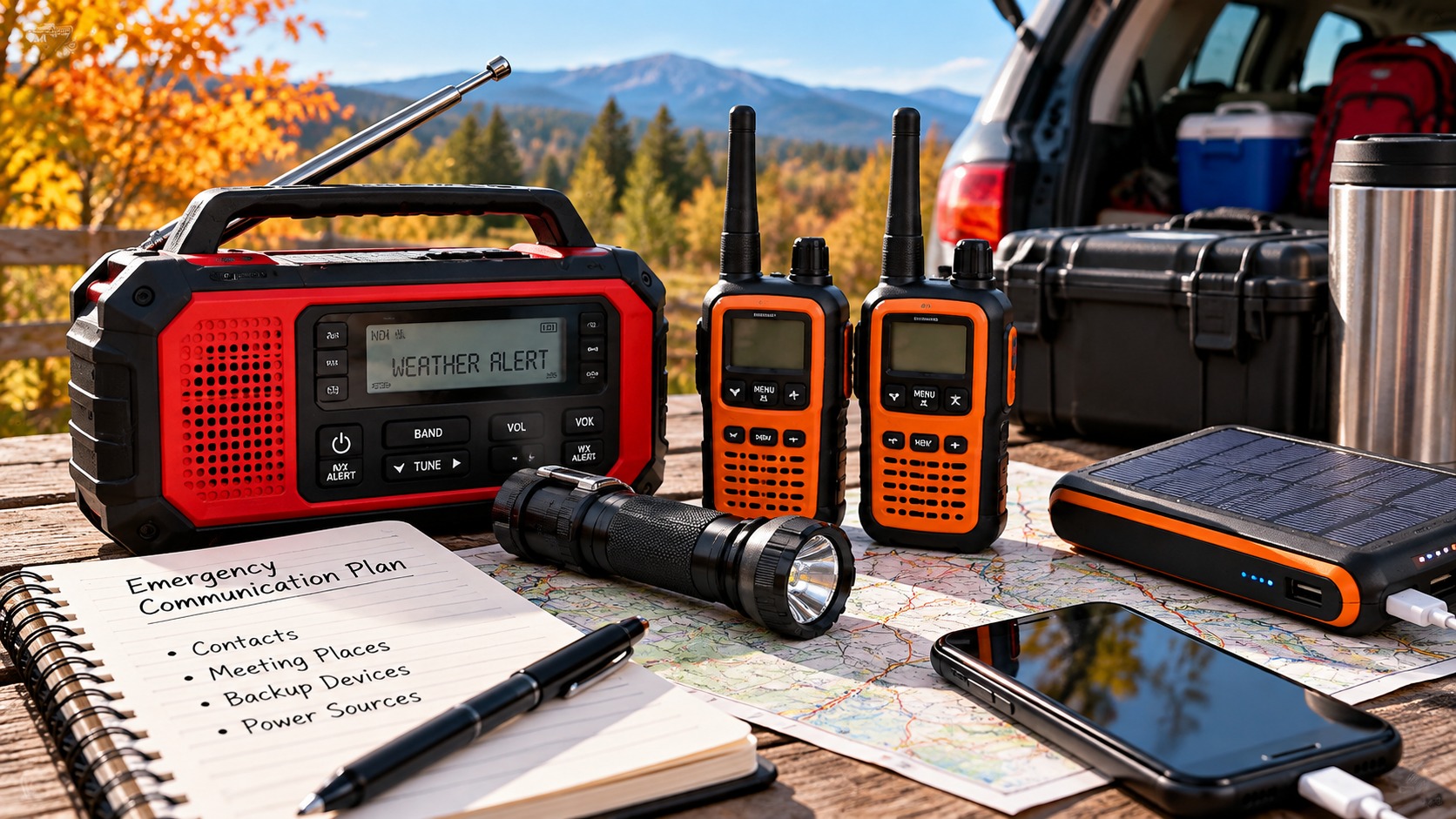
Your emergency communication equipment is only useful if it has power.
Portable power banks can keep phones and other USB devices operating during shorter outages or road emergencies.
Larger portable power stations can provide additional charging capacity during extended power outages. Solar chargers can also provide another option when normal electricity is unavailable.
Do not forget ordinary batteries, either.
Keep the correct battery sizes for your radios, flashlights, and other emergency equipment. Check them periodically and replace old batteries when necessary.
If you are driving to visit family this Thanksgiving, spend a few minutes checking your emergency communication supplies before you leave.
Charge your phone and power banks completely. Make sure charging cables are in the vehicle rather than sitting on the kitchen counter.
Check the batteries in your emergency radio and other devices.
Download offline maps for the areas you will be traveling through. Keep a paper map or road atlas in the vehicle as an additional backup.
You should also give a family member or friend your planned route and approximate arrival time, especially if winter weather is expected.
If you are traveling in more than one vehicle, decide how everyone will communicate if the group becomes separated.
A few minutes of preparation before pulling out of the driveway can prevent a much bigger problem later.
If cellular networks are overloaded, a text message may sometimes get through when a voice call will not.
Texts use less network capacity and may remain queued until service becomes available.
Instead of repeatedly calling family members during a widespread emergency, try sending a short message such as:
“I’m safe. Roads are bad. Stopping here. I’ll contact you again at 8.”
Keep messages brief and conserve your phone battery whenever possible.
Equipment is important, but a plan matters just as much.
Every household should decide in advance how family members will communicate if they become separated.
Choose an out-of-area contact who can serve as a central point of communication. During a local disaster, it may be easier to reach someone outside the affected area than someone nearby.
Make sure everyone has important phone numbers written down.
Yes, written down.
Many of us no longer memorize phone numbers because our phones remember them for us. If your phone is lost, damaged, or dead, those numbers may disappear with it.
Keep a printed contact list in your emergency kit, vehicle, wallet, or purse.
Your family plan should also include a meeting place in case you cannot communicate at all.
Communication problems do not only happen at home.
Imagine being stranded on a rural road during a November snowstorm with a dead phone and no way to tell anyone where you are.
That is why communication and charging supplies belong in your vehicle emergency kit.
Consider keeping a charged power bank, charging cables, emergency radio, flashlight, paper map, and written emergency contacts in your vehicle.
If you are preparing for Thanksgiving travel, check those supplies before your trip rather than assuming everything you packed last winter still works.
Cold weather, dead batteries, and forgotten charging cables have terrible timing.
Buying emergency equipment and putting it in a closet is not enough.
Test it.
Turn on your emergency radio and make sure you know how to find weather information.
Try your two-way radios from different locations.
Charge your power banks and confirm that your cables work with your devices.
Check batteries several times throughout the year.
You do not want to read an instruction manual for the first time while sitting in the dark during a storm.
There is no single perfect emergency communication device.
That is why having backups matters.
Your phone may work. If it does, great.
If it does not, you may still have a weather radio for information, two-way radios for nearby communication, a CB radio in your vehicle, GPS or maps for navigation, and backup power to keep essential devices running.
As Thanksgiving approaches, take a few minutes to review your family’s emergency communication plan before holiday travel begins.
Charge your devices. Check your batteries. Pack your backup gear. Make sure someone knows where you are going and when you expect to arrive.
Then keep those same preparations in place after the holiday is over.
Because storms, power outages, and communication failures do not check the calendar before they happen.